Form 2028 Survey Questionnaire
5-Star Safety Ratings Label Quantitative Concept Testing
03 - Monroney Quant Concept Testing - Survey Questionnaire_FINAL
5-Star Safety Ratings Label Quantitative Concept Testing
OMB:
OMB Control No. 2127-New
NHTSA FORM 2028
Expiration Date: Three years from date of approval
5-Star Safety Ratings Label Quantitative Concept Testing
QUESTIONNAIRE
Quantitative Survey – Study Overview
MODE: Mixed-mode quantitative survey (primarily online, supplemented with phone)
LENGTH: 14 minutes
LANGUAGE: Programmed in English
SAMPLE: n=1,000; Assumes 10-15% incidence rate
SAMPLE SOURCE: NORC AmeriSpeak Panel
QUALIFICATION CRITERIA:
U.S. Nationwide
Ages 18+
Possess current driver's license
Primary/shared decision maker for vehicle purchases in household
In purchase mindset (have purchased or leased a new vehicle in last 6 months or planning to purchase/lease new vehicle in next 12 months)
SECTION 100: Welcome and Screening
[BANK THE FOLLOWING TEXT ON THE SAME SCREEN AS Q100]
Thank you for agreeing to participate in this study that is being conducted on behalf of the National Highway Traffic Safety Administration (NHTSA). This collection of information is voluntary and will be used for formative purposes only so that we may develop communications programs designed to reduce the number of traffic-related injuries and deaths. We will not collect any personal information that would allow anyone to identify you. A federal agency may not conduct, or sponsor and a person is not required to respond to, nor shall a person be penalized for failure to comply with, a collection of information subject to the requirements of the Paperwork Reduction Act unless that collection of information displays a current valid OMB Control Number. The OMB Control Number for this information collection is 2127-NEW.
Completion of this survey is estimated to take an average of 14 minutes between screening and the main content of the survey, including the time for reviewing instructions, completing, and reviewing the collection of information. All responses to this collection of information are voluntary. If you have comments regarding this burden estimate or any other aspect of this collection of information, including suggestions for reducing this burden, please send them to: Information Collection Clearance Officer, National Highway Traffic Safety Administration, 1200 New Jersey Ave, SE, Washington, DC, 20590.
Note: Key demographics for respondents are maintained by the probability-based panel sample providers with whom we are planning to work. Therefore, to reduce respondent burden, we will not re-ask the following demographic questions: state of residence, age, sex, race, household income, urban vs rural area, education, employment, martial status and parental status.
BASE: ALL QUALIFIED RESPONDENTS
Q145. Do you currently have a valid driver’s license?
Yes
No THANK & TERMINATE
BASE: ALL QUALIFIED RESPONDENTS
Q150. Who is responsible for making vehicle-related purchase or leasing decisions in your household?
I am primarily responsible
I share this responsibility with someone else in the household
Someone else in the household is responsible THANK & TERMINATE
BASE: ALL QUALIFIED RESPONDENTS
Q155. Have you purchased or leased a new model year vehicle in the last 6 months?
Yes
No
BASE: NOT PURCHASED/LEASED IN LAST 12 MONTHS (Q150=2)
Q160. How likely are you to purchase or lease a new model year vehicle in the next 12 months?
Not at all likely THANK & TERMINATE
Not too likely THANK & TERMINATE
Somewhat likely
Very likely
Extremely likely
SECTION 200: Vehicle Safety Perspectives
BASE: ALL QUALIFIED RESPONDENTS
Q200. When purchasing a new vehicle, meaning a new model year vehicle, what are the three most important factors that you consider?
[SELECT UP TO THREE RESPONSES, RANDOMIZE & ANCHOR PUNCH 21]
Safety ratings
Price
Fuel economy
Standard equipment included
Optional equipment available
Advanced safety technology features
Entertainment or other interior technology features
Manufacturer reputation
Reliability
Appearance/external styling
Eco-friendly/environmental impact
Financing options
Dealer incentives
Warranty
Total cost of ownership
Country of origin
Comfort
Type of fuel the vehicle can use
Utility
Performance
Size
Something else (please specify Q200a.) __________
BASE: ALL QUALIFIED RESPONDENTS
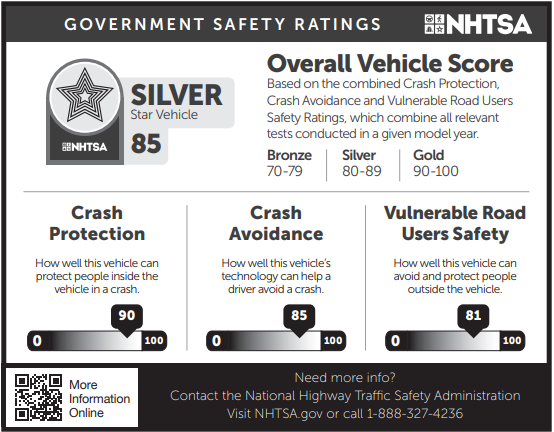
Q203. There are various factors that determine the safety of a vehicle, including how well it can withstand or avoid a crash. Another aspect of vehicle safety is how well a vehicle can avoid and protect people outside of the vehicle.
Thinking about this last type of vehicle safety, please indicate which of the following terms best describes a vehicle’s ability to avoid and protect people outside of the vehicle.
Non-Occupant Safety
Unprotected Road Users Safety
Safety Outside Vehicle
Vulnerable Road Users Safety
BASE: ALL QUALIFIED RESPONDENTS
Q204. One of the terms for a vehicle’s ability to avoid and protect people outside the vehicle that we showed you was Vulnerable Road Users Safety.
How well do you feel you understand what this term is referring to?
Do not understand
Understand a little
Understand somewhat
Understand well
Understand completely
BASE: ALL QUALIFIED RESPONDENTS
Q205. Now thinking of specific types of vehicle safety information, please use the scale below to rate how important the following would be when making a purchase decision.
If you are completing this study using a mobile device, please turn your device on its side for this question for an optimal experience.
Not at all important
Not too important
Somewhat important
Very important
Extremely important
[RANDOMIZE AND ANCHOR PUNCH D]
Crash protection rating (How well the vehicle can protect people inside the vehicle in a crash)
Crash avoidance rating (How well the vehicle can help a driver avoid a crash)
Vulnerable road users safety rating (How well this vehicle can avoid and protect people outside the vehicle)
Overall safety rating (A score that combines crash protection, crash avoidance, and vulnerable road users safety, which indicates the overall safety of the vehicle)
BASE: ALL QUALIFIED RESPONDENTS
Q210. You rated the overall safety rating as [INSERT Q205D RESPONSE]. How influential, if at all, are each of the following types of safety ratings on your perception of a vehicle’s overall safety?
If you are completing this study using a mobile device, please turn your device on its side for this question for an optimal experience.
Not at all influential
Not too influential
Somewhat influential
Very influential
Extremely influential
Crash protection rating (How well the vehicle can protect people inside the vehicle in a crash)
Crash avoidance rating (How well the vehicle can help a driver avoid a crash)
Vulnerable road users safety rating (How well this vehicle can avoid and protect people outside the vehicle)
BASE: ALL QUALIFIED RESPONDENTS
Q215. Below are two different perspectives of what it might mean for a vehicle to be a “safe vehicle.” Please indicate which of these two perspectives lies closer to your own.
[ROTATE STATEMENTS AND PUNCHES TO MATCH]
Smith defines a safe vehicle as one which prevents him from
getting into a crash.
Jones defines a safe vehicle
as one which protects him when he gets into a crash.
Completely agree with Smith
Somewhat agree with Smith
Not sure / neutral
Somewhat agree with Jones
Completely agree with Jones
SECTION 300: Safety Label Experience and Familiarity
BASE: ALL QUALIFIED RESPONDENTS
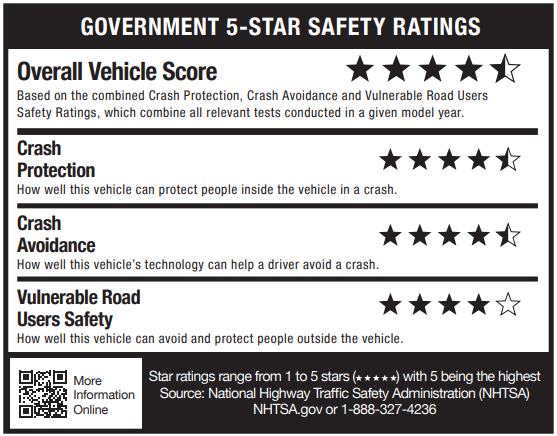
Q300. The government conducts crash tests to evaluate the safety of vehicles being sold in the United States. As part of the Government 5-Star Safety Ratings program, tested vehicles receive a rating of 1 to 5 stars, with more stars being safer. These Government 5-Star Safety Ratings are shown on the sticker that is required by law to be displayed on the window of new vehicles. Here is an example of the safety rating section of the window sticker:
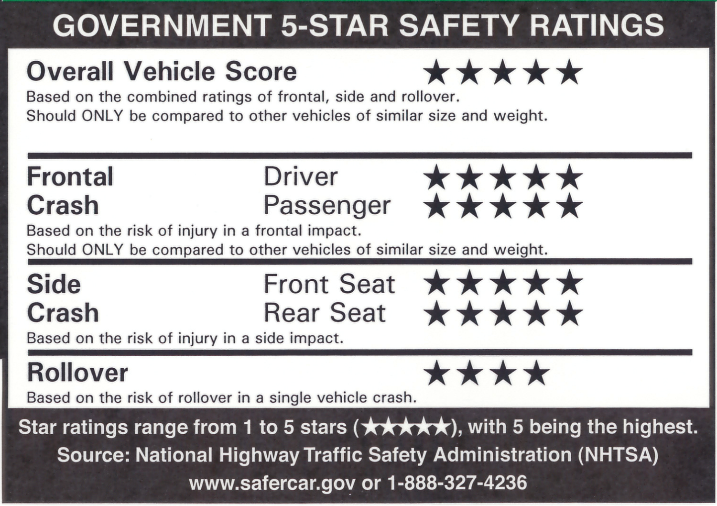
Prior to this survey, how familiar were you with the Government 5-Star Safety Ratings?
Never heard of it
Somewhat familiar
Very familiar
BASE: AT LEAST SOMEWHAT FAMILIAR (Q300=2-3)
Q305a. How influential, if at all, was the information from the Government 5-Star Safety Ratings section of the window sticker on your most recent new model year vehicle purchase?
Not at all influential
Somewhat influential
Very influential
I don’t remember/Unsure
I haven’t purchased a new model year vehicle before
BASE: NEVER HEARD OF OR HAVEN’T PURCHASED A VEHICLE BEFORE (Q300=1 OR Q305a=5)
Q305b. Imagine that you were planning to purchase a new model year vehicle. How
influential, if at all, would the information from the Government 5-Star Safety Ratings section of the window sticker be on your vehicle purchase?
Not at all influential
Somewhat influential
Very influential
I don’t remember/Unsure
BASE: ALL QUALIFIED RESPONDENTS
Q310. Please think about the safety label again. If you could make one change to improve the Government 5-Star Safety Ratings label – such as by adding new content or removing or changing existing content – what would you change?
[SHOW SAFETY LABEL]
[OPEN-END TEXT BOX]
SECTION 400: Concept Testing
In this next section, you will see three different design ideas for ways in which the safety label you saw earlier could be redesigned. Please take a minute to review each one carefully. After reviewing each design, you will answer a few questions about each design.
Please press the continue button to proceed to the first design. [CONTINUE BUTTON]
[RANDOMIZE ORDER OF CONCEPT TESTING SECTIONS]
[SHOW APPLICABLE DESIGN IMAGE WITH EACH QUESTION FOR ALL CONCEPT TESTING SECTIONS]
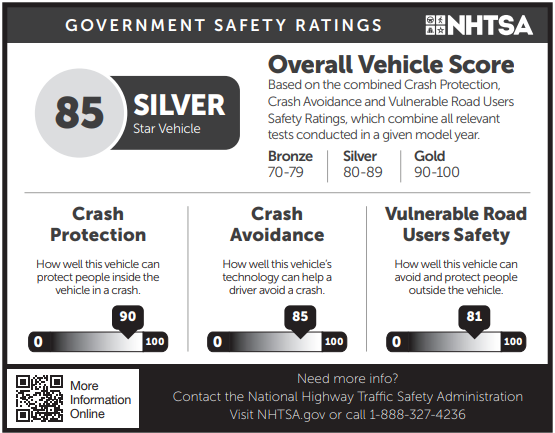
Concept Testing Section A (Q400a-Q425a) [SHOW DESIGN A – SEE APPENDIX]
Concept Testing Section B (Q400b-Q425b) [SHOW DESIGN B – SEE APPENDIX]
Concept Testing Section C (Q400c-Q425c) [SHOW DESIGN C – SEE APPENDIX]
Concept Testing Section Template:
[DESIGN IMAGE]
Please review the design carefully. Then, press the continue button to proceed to the questions.
[CONTINUE BUTTON]
BASE: ALL QUALIFIED RESPONDENTS
Q400a-c. How easy to understand is the information presented on the label?
Not at all easy
Not very easy
Somewhat easy
Very easy
Extremely easy
BASE: ALL QUALIFIED RESPONDENTS
Q405a-c. How well does the information in this concept grab your attention?
Not at all well
Not very well
Somewhat well
Very well
Extremely well
BASE: ALL QUALIFIED RESPONDENTS
Q410a-c. How helpful is the information on the safety label in making an informed decision about vehicle safety when purchasing or leasing a new vehicle?
Not at all helpful
Not very helpful
Somewhat helpful
Very helpful
Extremely helpful
BASE: ALL QUALIFIED RESPONDENTS
Q415a-c. How safe do you consider this vehicle?
Not safe at all
Not very safe
Somewhat safe
Very safe
Extremely safe
BASE: ALL QUALIFIED RESPONDENTS
Q420a-c. How well do you think this vehicle would protect you in a crash?
Not at all well
Not very well
Somewhat well
Very well
Extremely well
BASE: ALL QUALIFIED RESPONDENTS
Q425a-c. How well do you think it would prevent you from getting in a crash?
Not at all well
Not very well
Somewhat well
Very well
Extremely well
BASE: ALL QUALIFIED RESPONDENTS
Q430. Now I want you to look at each of the three designs together. Please select the design you feel is most effective at conveying safety information.
[USE GRAPHICS OF CONCEPTS A-C AS RESPONSE OPTIONS]
Design A
Design B
Design C
SECTION 500: Effective Language
This next section will focus on the language used to talk about vehicle safety.
BASE: ALL QUALIFIED RESPONDENTS
Q500. Many modern vehicles are equipped with an array of technologies designed to decrease the likelihood of that vehicle getting into a crash. There are different ways to talk about the function of these technologies. One way is to describe their function as [ROTATE] crash prevention and another is [ROTATE] crash avoidance. Which of these terms, if either, do you prefer for describing the function of these technologies?
[ROTATE TO MATCH QUESTION TEXT]
Strongly prefer crash prevention
Somewhat prefer crash prevention
No preference
Somewhat prefer crash avoidance
Strongly prefer crash avoidance
BASE: ALL QUALIFIED RESPONDENTS
Q505. Below are a series of phrases that could be used to communicate that a vehicle is exceptionally safe overall. With that intent in mind, what is your reaction to each phrase?
If you are completing this study using a mobile device, please turn your device on its side for this question for an optimal experience.
[SETUP AS GRID]
Strongly negative
Somewhat negative
Neutral/Not sure
Somewhat positive
Strongly positive
[RANDOMIZE ORDER OF ITEMS; REPEAT SCALE AFTER 3 ITEMS]
All-Star Safety Choice
All-Star Safety Performer
Safety-driven Vehicle
Top Safety Performer
Top Safety Choice
Safety Standard Achievement
Safety Gold Medal
Top Safety Rated
BASE: ALL QUALIFIED RESPONDENTS
Q510. Looking at the same list of phrases, select the one phrase that would be most influential in your decision to purchase a vehicle by communicating that a vehicle is exceptionally safe overall.
[SELECT ONE; RANDOMIZE ORDER OF ITEMS]
All-Star Safety Choice
All-Star Safety Performer
Safety-driven Vehicle
Top Safety Performer
Top Safety Choice
Safety Standard Achievement
Safety Gold Medal
Top Safety Rated
SECTION 600: Additional Questions
[Q600 SERIES INTRO]
The next few questions will ask your opinion of some ways the Government 5-Star Safety Ratings label could be revised to make the safety information better stand out.
Please review the current version of the safety label again to refresh your memory, then press the continue button.
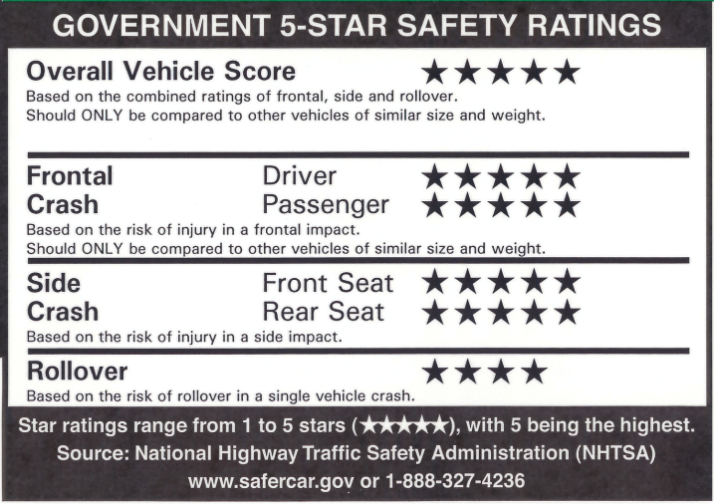
[CONTINUE BUTTON]
[SHOW EACH ITEM AS A SEPARATE PAGE]
BASE: ALL QUALIFIED RESPONDENTS
Q600. Please rate how effective the following change would be in making the safety information better stand out. The image is one way this change could be executed.
If you are completing this study using a mobile device, please turn your device on its side for this question for an optimal experience.
[SETUP AS GRID]
Not at all effective
Not too effective
Somewhat effective
Very effective
Extremely effective
[RANDOMIZE ORDER OF ITEMS; REPEAT SCALE AFTER 3 ITEMS]
Displaying the 5-star safety information in a different color
Include more white space for legibility
Fit each rating category description on one line
Add a government seal or NHTSA logo to add credibility
Include half-star ratings (e.g., 3.5 or 4.5 stars) to allow more gradations of quality
BASE: ALL QUALIFIED RESPONDENTS
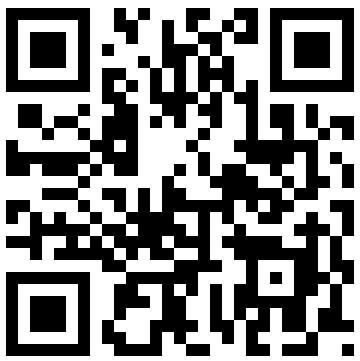
Q605. A QR code, like the image shown below, is a kind of barcode that can be scanned by a
mobile phone to link to a website. When, if ever, did you last use a QR code to access a website, menu, or other digital link?
I’ve never used a QR code before
More than a year ago
More than a month ago, but within the last year
More than a week ago, but within the last month
Within the last week
BASE: ALL QUALIFIED RESPONDENTS
Q610. How often do you typically use QR codes to access a website, menu, or other digital link?
Never [AUTOFILL FOR Q615=1]
Rarely [AUTOFILL FOR Q615=2]
Occasionally
Sometimes
Often
BASE: ALL QUALIFIED RESPONDENTS
Q615. The amount of information that can be included on the safety label is limited by space. To provide as much information to consumers as possible, some people have suggested adding a QR-code to the label which would lead to an official government website with additional safety information and ratings.
How likely would you be to visit this QR-accessible website at the point of sale (e.g., in the dealers’ lot)?
Not at all likely
Not too likely
Somewhat likely
Very likely
Extremely likely
BASE: ALL QUALIFIED RESPONDENTS
Q620. Below is a list of crash avoidance systems that help drivers to drive more safely. For each item, please indicate whether that technology is or is not equipped on your vehicle or on a vehicle that you regularly drive or ride in as a passenger.
Please click on the blue text to see the full definition of each technology.
[RANDOMIZE; DISPLAY BRACKETED TEXT WITH CLICK]
Forward Collision Warning [Detects a potential collision with a vehicle ahead and alerts the driver. Some systems also provide alerts for pedestrians and other objects.]
Lane Departure Warning [Monitors vehicle’s position within the driving lane and alerts the driver as the vehicle approaches or crosses lane markings.]
Rear Cross Traffic Warning [Detects vehicles approaching from the side at the rear of the vehicle while in reverse gear and alerts the driver. Some systems also warn for pedestrians or other objects.]
Blind Spot Warning [Detects vehicles in the blind spot while driving and notifies the driver to their presence.]
Automatic Emergency Braking [Detects potential collisions with a vehicle ahead and automatically brakes to avoid a collision or lessen the severity of impact. Some systems also automatically brake for pedestrians or other objects.]
Rear Automatic Braking [Detects a potential collision while in reverse and automatically applies brakes if a crash is imminent. Some systems also automatically brake for pedestrians or other objects.]
Blind Spot Intervention [Applies brakes or provides steering if the driver begins to change to a lane where a vehicle is detected in the blind spot.]
Adaptive Cruise Control [Cruise control that also assists with acceleration and/or braking to maintain a driver-selected gap to the vehicle in front.]
Lane Centering Assistance [Provides continual steering to keep vehicle centered in its lane.]
Lane Keeping Assistance [Provides steering support to assist the driver in preventing the vehicle from departing the lane. The system reacts only when the vehicle approaches or crosses a lane line or road edge.]
Automatic High Beams [Switches between high and low beam headlamps automatically based on lighting and traffic.]
Back-up Camera [Displays the area behind the vehicle when in reverse gear.]
Automatic Crash Notification [An automatic crash notification system notifies emergency responders that a crash has occurred and provides the vehicle’s location.]
No, my vehicle does not have this feature
Yes, my vehicle has this feature
I’m not sure
BASE: ALL QUALIFIED RESPONDENTS
Q625. Do you agree or disagree with the statement that crash avoidance systems – such as those listed in the previous question – work as they are intended to and can help you drive more safely?
Completely disagree
Somewhat disagree
Not sure
Somewhat agree
Completely agree
BASE: ALL QUALIFIED RESPONDENTS
Q630. When it comes to operating vehicles, do you generally think that humans or technology are safer?
Technology is much safer
Technology is somewhat safer
Humans are somewhat safer
Humans are much safer
Thank you very much for taking the time to complete our survey. Your responses are greatly appreciated.
APPENDIX: Designs
|
Design A |
|
Design B |
|
Design C |
| File Type | application/vnd.openxmlformats-officedocument.wordprocessingml.document |
| Author | Sharon Hegarty |
| File Modified | 0000-00-00 |
| File Created | 2025-12-31 |
© 2026 OMB.report | Privacy Policy